 051 845648
 info@seam.ie

Case Study Overview
The Challenge
Mixing these two air streams to produce an air supply with a uniform temperature profile can be particularly challenging, as external air temperatures can reach far below zero during winter. In order to evaluate the mixing performance of each AHU in line with project requirements, EDPAC approached SEAM to carry out air flow assessments using computational fluid dynamics (CFD), an engineering simulation technique for analysing fluid flow phenomena.
Why SEAM
SEAM utilises engineering simulation and analysis to solve problems across a wide variety of industries. SEAM has expertise in structural analysis involving Finite Element Analysis (FEA), as well as CFD for the analysis of fluid flow phenomena. To date, EDPAC has collaborated with the SEAM Technology Gateway on several data centre air handling unit (AHU) design projects involving free air cooling. Free air cooling takes advantage of low external air temperatures by mixing low temperature fresh air with internal room temperature air.
The Solution
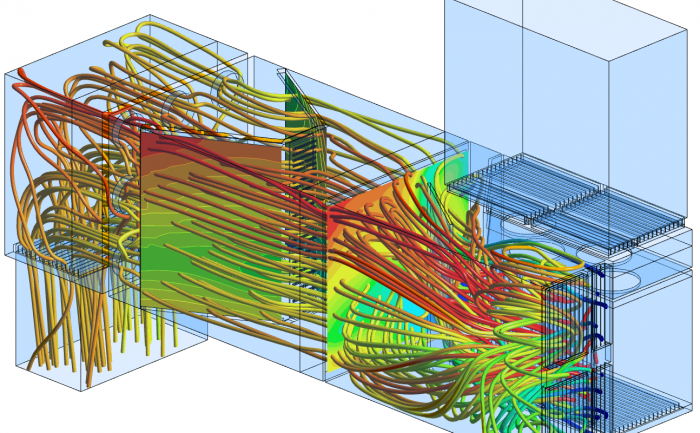
SEAM built a computational model of each AHU, and simulated air flow under critical winter conditions. SEAM then analysed the resulting air flow patterns and temperature distributions to evaluate mixing performance, and to identify design modifications to improve mixing.
The Outcome
The use of CFD on this project allowed EDPAC to confirm the performance of each AHU according to project requirements at the design stage. The detailed engineering simulation approach has given EDPAC additional insight into the design of AHUs for free air cooling applications involving low external air temperatures